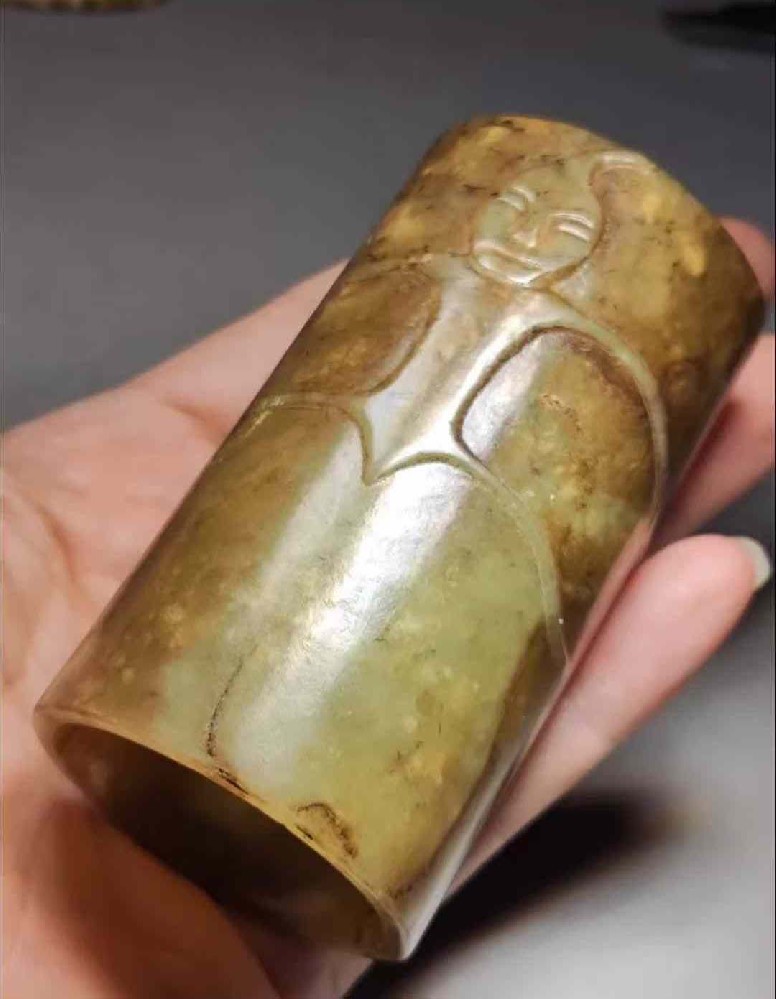
The Shang Dynasty was a unified multi-ethnic centralized state with a complete patriarchal ritual system. Jade became a treasure exclusively enjoyed by the emperor. There were many varieties. In addition to religious utensils, there were also tools, daily necessities, accessories and decorative jades. Among these varieties, ritual vessels and round-carved figures are the most precious, such as jade seals, jade cong, jade bi, etc., and figure carvings are the best. Round-carved animals and containers are second only to figure jade carvings and are also of great collection value. Because the round carving of figures and animals is difficult and has realistic artistic characteristics, it can reflect some social aspects of the time, so it has high artistic value, economic value and scientific value. Other jades in the Shang Dynasty were mostly tools and weapons, and the craftsmanship was also divided into high and low levels of fineness and coarseness. Ritual vessels or weapons were made more finely and the shapes were more beautiful, so this type of jade is also of great collection value. Jade in the Shang Dynasty of China. According to the analysis of unearthed objects, it can be divided into early and late periods.
The representative jade artifacts of the early Shang Dynasty (about the beginning of the 17th century BC to around the 11th century BC) are the jade artifacts unearthed from the Erlitou site and tombs in Yanshi, Henan Province, including jade gui, jade cong, jade huang, jade knife, jade pavilion, jade staff, jade axe, jade shovel, and handle-shaped objects with animal face patterns. The jade gui, jade staff, and jade pavilion are all new forms that appeared at this time. The body of the artifact is extremely thin and should be a ritual object. The seven-hole jade knife with intaglio patterns is 65 cm long, 9.6 cm wide, and only 0.1 to 0.4 cm thick; the jade staff is 48.1 cm long and 7.8 cm wide. Such large and thin objects are not practical and must have other uses. To make such slender jade artifacts, it is necessary to saw the material from a large piece of raw jade first. This workmanship is not seen in the jade artifacts of the Hongshan culture. It is also different from the method of peeling the jade cong into a square columnar jade blank in the Liangzhu culture, which reflects the progress of jade making technology in the early Shang Dynasty. The larger handle-shaped jade is 17.1 cm long and 1.8 cm wide, divided into 10 sections, two of which are carved with animal face decorations, which are fine and bright, and the eyes and mouth are expressed with positive lines, which seems to be the predecessor of Yinxu animal face jade. It can be seen that the jade cutting and grinding technology at this time has made certain progress compared with the jade making technology of primitive society, and new shapes and new decorative techniques have emerged.
The remains of the early and late Shang Dynasty are represented by the Erligang site in Zhengzhou. Jade halberds, jade daggers, jade huang, jade handle-shaped objects and small ornaments have been unearthed in Shang Dynasty sites and tombs such as Minggong Road, Baijiazhuang, People's Park, Panlongcheng, Huangpi, Hubei, Taixi, Gaocheng, Hebei, and Liujiahe, Pinggu, Beijing. The jade dagger unearthed from Panlongcheng, Huangpi is 93 cm long, which is the longest jade dagger known so far. There is no major change in the jade making process at this time, but some of them are larger in shape and the negative lines are more refined.
The late Shang Dynasty refers to the period after Pan Geng moved to Yin (14th century BC to 11th century BC). The 11 large tombs in the royal tomb area of Yinyi (now the northwest suburb of Anyang City, Henan Province) were all looted, and very few jades survived, including small pieces such as jade daggers, jade staffs, jade knives, owl-shaped jade pendants, and buffalo-shaped jade pendants. Fu Hao's tomb was not looted, and 755 jades were unearthed. Including the late Shang Dynasty jades unearthed after 1949, there are about 1,200 pieces. In terms of craftsmanship and style, there are royal jades, slave owner jades, and Fangguo jades. For example, the inscriptions on some unearthed jade daggers indicate that they were made by Taoguo and Lufang; judging from the materials and shapes of some unearthed jades, they came from the Longshan and Liangzhu cultural circles; the content of "taking jade" or "checking jade" in the oracle inscriptions reflects the diversity of the sources of jades in the late Shang Dynasty.
Source of Jade According to the visual observation of senior jade workers, there is Xinjiang Hetian jade in the Shang Dynasty jade, which pushes the history of Hetian jade to the late Shang Dynasty. In addition, there are Yuyu, Dushan jade and colored jade from other places, indicating that the Yin royal family did "take jade" and "conquer jade" from Fangguo. Function of Jade The types and quantity of jade in the late Shang Dynasty increased compared with the early Shang Dynasty and ancient times, indicating that the function of jade was gradually expanding. The new jade artifacts unearthed in Yinxu from the late Shang Dynasty include dozens of pieces such as gui, plates, combs, ear spoons, 筚, jade chains, as well as tigers, elephants, bears, deer, monkeys, horses, cows, dogs, rabbits, sheep heads, bats, cranes, eagles, owls, parrots, swallows, cormorants, geese, ducks, mantises, cicadas, silkworms, snails, phoenixes, strange birds, monsters, various figures, etc., which can be divided into 7 categories according to their uses:
① Ritual vessels. Jadeware used for worshipping the gods of heaven and earth, ancestors and for witchcraft, such as bi, ring, yuan, jue, huang, gui, cong, gui, pan, etc.
② Ritual vessels. Ritual vessels worn by kings and concubines during celebrations, such as swords, spears, qi, yue, etc. Although they are similar in shape to weapons, they cannot be used in actual combat and are only used as a symbol of rank. In addition, some animal jades with grooves and tenons may also be ritual vessels.
③ Tools. Jade tools used for handicrafts and farming, including axes, chisels, shovels, saws, knives, shovels, sickles, spinning wheels, etc. Since most of them have no signs of use, they may also be used for personal decoration.
④ Utensils. Jadeware used for daily utensils includes mortars, pestles, plates, combs, ear spoons, daggers, hairpins, etc. Mortars and pestles are used to grind beads, sand and other pigments, plates can be used to mix pigments, combs, ear spoons, daggers, hairpins are all daily necessities, and is a tool for drawing bows and strings.
⑤ Ornaments. Wearable jade articles include hairpins, bracelets, beads, tubes, pendants, animal-shaped jade articles, etc.
⑥ Display items. Animal jade carvings without holes, grooves, or mortise and tenon joints are display jade.
⑦ Funeral objects. At this time, only block-shaped or cicada-shaped jade articles placed in the mouth of the deceased were seen, which was the prototype of later funeral jade articles.
There are also some with unknown functions, such as seat-shaped objects, cane-shaped objects, dagger-shaped objects, column-shaped objects, or long-handled objects.
In short, the early jade articles of the Shang Dynasty were represented by straight Yin lines and thin ritual jade articles; the jade art of the late Shang Dynasty had symbolic and decorative characteristics, such as some three-dimensional jade carvings of people, animals, and birds, which mainly highlighted the characteristics of their heads, eyes, teeth and other organs, omitted trivial details, and made symbolic outlines, while important details were given round and beautiful Yang lines, showing a strong decorative interest. This highly unified artistic technique of symbolism and decorativeness is the mainstream of jade carving in the late Shang Dynasty. In addition, simplified jade articles such as jade fish and jade knives also appeared. Both of these jade craftsmanship tendencies originated in ancient times and developed, laying the foundation for the progress of jade articles in the Western Zhou Dynasty.
Please note: This product is stored in China. If you order this product, please accept the time it takes for the express delivery from China to the United States. Of course, we will use the fastest express delivery method, and the estimated time will increase by 2-3 weeks.